

Commercial Pedicure Chair Buying Guide
Buying Guides / Field Notes

Published by the Shuangjin Furniture export team — a manufacturer of commercial spa and salon furniture since 2006.
A commercial pedicure sofa is one of the highest-utilization assets on any salon, spa, or hotel wellness floor — and the wrong choice can quietly drain profit for years. Procurement managers who treat it as a commodity line item usually pay for that mistake through downtime, warranty gaps, and replacement cycles that no budget forecast predicted.
When a single reclining sofa fails during peak season, the station can sit out of service for weeks while a replacement is arranged. That downtime — plus a disrupted appointment book and refund requests — costs far more than the unit itself.
Most equipment purchases still happen the same way: a buyer compares two catalog photos, picks the lower price, and discovers the real problems only after the motor burns out, the PU cracks, or the drainage backs up — usually after the warranty has lapsed or the supplier has moved on.
This guide is written specifically for B2B buyers — salon chain owners, spa procurement managers, hotel wellness directors, and distributors — who need a defensible specification rather than a sales pitch. We will show you which specs separate commercial-grade equipment from showroom decoration, how to read a total cost of ownership (TCO) sheet, and how to source directly from a manufacturer without surrendering compliance or customization.
You will learn the seven dimensions every procurement manager should specify, why pipeless systems now dominate this segment, how to read build and service levels, and a step-by-step factory-direct workflow from sample to shipping container.
Key Takeaways
– Pipeless commercial pedicure sofa models are the more common choice in this segment, and are now the default for new B2B hygiene and serviceability requirements.
– Quality commercial units keep their mechanism and parts support well beyond the entry tier; low-cost imports often fail early, which multiplies total cost of ownership.
– Specifying a stated frame load rating, a documented motor cycle rating and a low noise floor is what separates salon-grade from consumer-grade equipment.
– Warranty terms vary by market and are negotiated per order; confirm the exact coverage in the quotation and contract, because it directly affects your 5-year TCO.
– Factory-direct sourcing (sample → factory audit → QC → container → Incoterms) lowers unit cost and unlocks logo, color, size, and free space-planning customization at MOQ.
1. What Makes a Pedicure Chair “Commercial-Grade”?
The label “commercial” is not a marketing adjective — it is a structural and regulatory distinction. A commercial pedicure sofa is engineered for continuous daily use by multiple technicians and hundreds of clients per week. Light-use furniture is built for occasional operation and fails quickly under salon conditions. This guide covers only commercial scenarios — the kind of pedicure sofa for salon, spa, hotel, resort, or distribution use.
Three structural signals tell you whether a commercial pedicure sofa is genuinely commercial-grade:
- Frame and base: A reinforced frame — steel, aluminum, or hardwood — rated for the loads you actually expect, with a tested lift mechanism and a documented test report. Confirm the material and rating for the specific model, not the category.
- Upholstery system: Commercial PU or microfiber leather (often called super-fiber leather) rated for acetone, oils, and daily disinfection — not untreated fabric or delicate full-grain leather that stains on contact.
- Motor and plumbing: A certified motor with a documented cycle life and a pipeless or plumbed basin system designed for repeated drainage and sanitation.
Reclining Foot-Bath Sofa vs. Upright Chair: A Category Clarification
A growing share of B2B buyers are specifying what the industry calls a foot bath sofa — a reclining, sofa-style pedicure station with an integrated foot-bath basin, often fuller in profile than the classic upright throne chair. The Chinese manufacturing term 足浴沙发 describes the same category, and it is a lower-competition segment with strong product differentiation and high comfort for longer spa treatments.
For buyers comparing options, the practical distinction is posture and treatment length. An upright pedicure spa chair suits high-throughput nail salons where speed matters. A reclining foot-bath sofa suits spa, wellness, and hotel environments where the client reclines for 45–90 minutes. Both are commercial; the right choice depends on your service menu and floor space. Review our foot spa sofas & pedicure sofas to compare both postures.
Mini story — the downtime tax. An owner who runs a three-station nail salon bought two low-cost units to save on opening costs. While the units were still under warranty both motors failed and the PU split along the seam. With no local service partner and a supplier who stopped replying, she ran one station for six weeks. Across a full appointment book, the lost revenue alone exceeded what a pair of properly specified commercial units would have cost. The cheap purchase was, in retrospect, the expensive one.
2. What Buyers Now Compare: Pipeless, Plumbed and Factory-Direct
Procurement teams now compare three things before they compare cost: how the basin drains, who services the motor, and how much of the build the supplier actually controls. A pipeless unit carries its own water system and needs no building plumbing; a plumbed unit ties into drainage and supply for a permanent station; a portable unit trades build weight for flexibility.
The same shift explains why more buyers deal with the factory rather than a trading company. When frame, foam, upholstery and packing happen under one roof, the specification you sign is the one that ships, and the spare-parts route stays open after the warranty ends.
3. 7 Selection Dimensions Every Procurement Manager Should Specify

A specification sheet is only useful if it forces vendors to disclose what matters. These seven dimensions should appear on every RFQ you send.
3.1 Foot-Bath System: Pipeless vs. Plumbed vs. Portable
The basin is the heart of the station. Pipeless units circulate water through a self-contained, easily sanitized system — lower contamination risk and simpler maintenance, now the market majority. Plumbed chairs connect to building drainage and supply for a permanent installation but require plumbing labor and fixed positioning. Portable units are lightweight and plug-and-play for mobile or temporary setups, sacrificing durability and comfort.
For most salon and spa rollouts, pipeless is the recommended default unless your facility already has dedicated drainage rough-ins and you want a fixed installation.
3.2 Frame & Load Capacity
Specify a reinforced frame with a verified load rating — 200 kg+ is a sensible target for commercial use. The failure mode here is not the seated client — it is the combined load of the client, the technician leaning in, and the reclined mechanism under repeated lift cycles. Ask for the tested lift-cycle count, not just the static weight limit. A commercial frame should withstand tens of thousands of up-down cycles without play in the joints.
3.3 Upholstery: PU vs. Leather vs. Velour
Commercial upholstery lives under acetone, cuticle oil, water, and disinfectant several times daily. PU (polyurethane) and microfiber leather (super-fiber leather) dominate commercial pedicure furniture because they are waterproof, stain-resistant, and easy to wipe clean — and they hold up far longer than untreated fabric. Full-grain leather stains on first contact with acetone and is impractical for salon use; velour or velvet finishes exist on a minority of spa models for tactile comfort but require more careful maintenance.
Specify PU or microfiber leather as the baseline, confirm acetone resistance in the material data sheet, and treat any “genuine leather” claim with skepticism for high-volume stations.
3.4 Motor & Mechanism
The motor is the component most likely to fail and the most expensive to replace. Look for a verified cycle rating and a low noise floor. A motor with a documented cycle rating, a stated load rating and a low noise floor is the commercial benchmark worth specifying. Noise matters more than buyers expect: a loud whine in a quiet spa breaks the relaxation experience and draws complaints.
3.5 Adjustability & Ergonomics
Technician ergonomics drive labor retention. Specify adjustable seat height, reclining backrest, and a footrest that lets the technician work without hunching. For reclining foot-bath sofas, confirm the full recline angle and quick return to upright between clients. Adjustments that take seconds — not tools — keep turnaround fast.
3.6 Power & Compliance
Commercial imports must clear customs and meet local electrical and plumbing codes. Specify voltage and plug type for the destination so the same build can be configured for each market without rewiring. Confirm the relevant certifications for your destination:
Confirm which electrical and plumbing approvals your destination requires, and ask whether the supplier ships the documentation with the container. Missing paperwork is a common cause of customs delay.
Compliance documentation should travel with the shipment. Missing certificates are the most common cause of containers held at port.
3.7 After-Sales: Warranty & Spare Parts
Warranty terms in this category vary by market and are negotiated per order. That matters for TCO: a chair failing in year four becomes a full capital replacement. Confirm the exact coverage — and which components it includes (motor, control board, basin) — in the quotation and contract, since a longer agreed term spreads repair cost across more years. Equally important is spare-parts availability: confirm the vendor stocks motors, basins, and control boards, and ask for the stated replacement lead time in writing.
Want to see how warranty coverage and spare-part lead time change your 5-year TCO? Request a quote for volume pricing and MOQ on commercial-grade models.
4. Commercial Pedicure Chair Types Compared

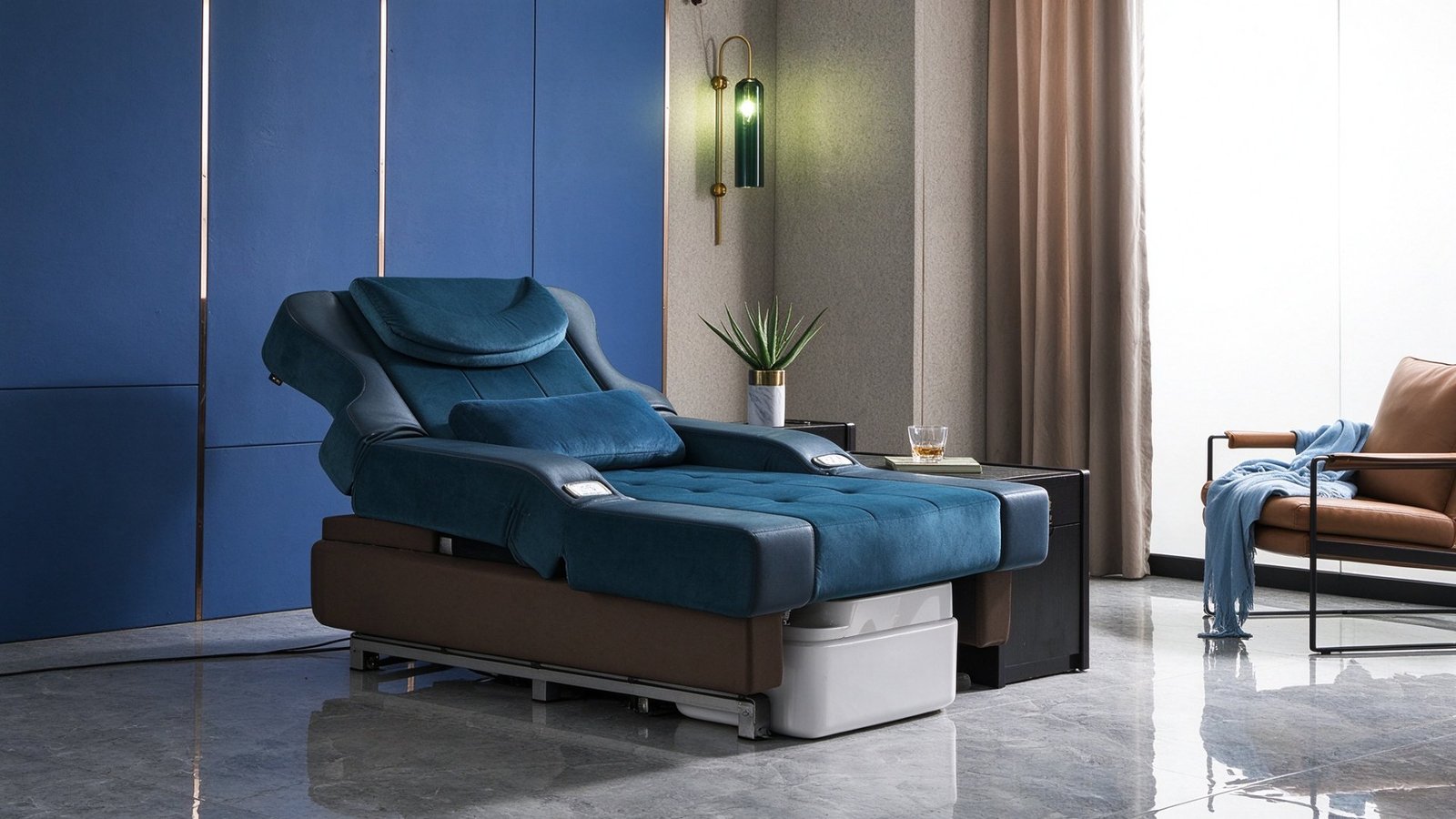
The four commercial archetypes serve different service models. Use this specification table to map the right type to your floor plan and client volume.
| Type | Posture | Basin System | Typical Load Rating (verify per model) | Best For | Typical Commercial Price Tier |
|---|---|---|---|---|---|
| Portable | Upright, lightweight | Self-contained, no plumbing | ~120–150 kg | Mobile techs, pop-up events, overflow | Entry |
| Pipeless Spa Chair | Upright, powered recline | Pipeless, lined/self-contained jet | Confirm per model | High-throughput nail salons | Standard |
| Luxury Throne | Upright, heavy padding | Pipeless or plumbed | 200 kg+ | Premium salons, branding statements | Premium |
| Reclining Foot-Bath Sofa | Fully reclining sofa form | Integrated pipeless basin | 200 kg+ | Spas, wellness, hotels, long treatments | Premium |
The reclining foot-bath sofa deserves a special note for B2B buyers: it captures the comfort expectations of a spa day while keeping the integrated basin that defines a commercial pedicure sofa. For chains building a differentiated, photogenic treatment room, it is the fastest-rising category.
5. Total Cost of Ownership, Not List Price
List price is the least important number on a procurement sheet. Total cost of ownership across the working life tells the real story.
Treat the tiers as build and service levels, not as price bands. Entry units are portable and lightly built; standard units pair a commercial motor with a pipeless or plumbed basin; premium units add a reclining foot-bath sofa body, heavier padding and a longer service life. Compare them on the written specification, the warranty terms and the spare-parts route, not on a headline figure.
A simple TCO formula: TCO = (unit price + freight + duties) + (expected service calls × cost) − (warranty-covered repairs), calculated across the expected service life; divide the total by that life in years to get an annual cost figure. Buyers who run this once stop comparing sticker prices and start comparing cost-per-client-appointment.
Mini story — the chain that standardized. A multi-site spa group kept inheriting mismatched sofas from individual sites: four brands, six colors, three basin types. Their procurement lead ran a TCO comparison and found they were paying premium rates on small batches with no visual consistency. By consolidating on one OEM-spec reclining foot-bath sofa — same logo, same charcoal microfiber, same basin — across all locations, they cut per-unit cost through volume, simplified technician training, and turned the treatment room into a recognizable brand asset. Consistency, not the lowest bid, delivered the saving.
6. Customization & OEM/ODM: Consistent Brand Across Locations

For chains and distributors, customization is a margin and brand lever, not a luxury. A manufacturer offering full-dimension OEM/ODM can match your size, color, function, and brand logo to a single spec sheet applied across every location.
The capabilities worth specifying:
- Logo and colorway: Embossed or stitched branding in your palette, applied uniformly.
- Dimensions: Adjusted seat width, recline angle, and base footprint to fit your room layout.
- Function set: Basin type, massage module, and control placement matched to your service menu.
- Free space planning: A manufacturer that provides complimentary store-layout planning helps you maximize chairs-per-square-meter and circulation space before you commit to a container.
Your pedicure sofa MOQ depends on customization depth — light logo/color changes sit lower than full structural redesigns. Confirm the exact MOQ in writing during quotation, because it determines both your working capital and your per-unit price break.
7. How to Source Factory-Direct from a Manufacturer
Whether you need a single unit or pedicure sofa wholesale volumes, bypassing distributors protects margin — but it shifts responsibility to your team. A disciplined factory-direct workflow looks like this:
- Sample: Order 1–2 production samples (not showroom units) and stress-test them in a real station for two weeks.
- Factory audit: Verify the production base, workforce, and quality system. A self-built factory that keeps every stage in-house — frame, foam, fabric, upholstery, inspection, packing — is a different risk profile from a trading company with no plant.
- QC protocol: Agree on pre-shipment inspection points — frame weld, motor cycle test, upholstery seam, basin leak test, and electrical compliance check.
- Container & Incoterms: Choose your Incoterm (FOB, CIF, DDP) based on whether you or the supplier controls freight and insurance. DDP simplifies landing but raises unit cost; FOB gives you freight control.
- Lead time: Confirm realistic production and container timelines, especially around peak seasonal demand.
- Customs clearance: Ensure the approval documents your destination requires and the commercial invoice accompany the shipment to avoid port holds.
Planning a multi-container order? Our team provides free store space planning and confirms MOQ, lead time, and Incoterms before you commit — start your factory-direct quote here.
8. Why Shuangjin: In-House Production, Custom Builds
As a pedicure sofa manufacturer, Shuangjin publishes the following verifiable facts.
Founded in 2006, the operation runs a self-built production base where every stage stays in-house. Pedicure sofas and spa massage beds are built entirely in-house with no outsourced processes: frame cutting, punching, welding, assembly, sewing, foam work, inspection and packing all happen under one roof. Shipments go to Europe, North America, Southeast Asia, Africa and Australia.
After-sales is handled per market: warranty terms are negotiated per order and written into the quotation and contract, while PU / microfiber leather upholstery is waterproof, stain-resistant, and easy to clean. Full-dimension customization — size, color, function, and brand logo — plus complimentary space planning rounds out the B2B offer. OEM & ODM service, sample making, and DDP logistics are available. Every product is built to the buyer’s specification rather than pulled from a fixed catalog.
To verify these claims directly, review the factory capability page and the company background. For a representative model in the reclining foot-bath sofa line, see the MZ-095A pedicure sofa.

9. Commercial Pedicure Chair FAQ
Q1: What is the difference between a pipeless and a plumbed commercial pedicure chair?
A pipeless unit circulates water through a self-contained, easily sanitized system with no shared building plumbing, reducing contamination risk. A plumbed chair connects directly to drainage and water supply for a permanent installation. Pipeless units are the more common choice in this segment.
Q2: How long should a commercial pedicure chair last?
There is no single figure that holds across models. Service life depends on how many hours a day the unit runs, how the water system is cleaned, whether the mechanism is serviced on schedule, and whether spare parts remain available. Ask the supplier for the service interval and the parts list in writing.
Q3: What load capacity should I specify?
Specify a reinforced frame with a verified load rating — 200 kg+ is a reasonable commercial target — to cover the client plus technician lean and repeated recline cycles. Static weight limits alone are not sufficient.
Q4: Which certifications do I need for import?
It depends on the destination. Ask which electrical and plumbing approvals are required where the furniture will be installed, and whether the supplier ships the matching documentation with the container. Missing paperwork is a common cause of customs delay.
Q5: What upholstery is best for a salon or spa?
PU or microfiber (super-fiber) leather is the commercial standard — waterproof, acetone-resistant, and easy to disinfect. Full-grain leather and untreated fabric are impractical for high-volume stations.
Q6: What does MOQ mean for customization, and how low can it go?
MOQ is the minimum order quantity required for a custom spec. Light logo and color changes typically carry a lower MOQ than full structural redesigns. Confirm the exact number during quotation.
Q7: How do Incoterms affect my landed cost?
Incoterms define who controls freight, insurance, and risk. FOB lets you manage shipping; CIF/DDp simplify landing but raise unit cost. Your choice directly changes total cost of ownership.
Q8: Why does noise level matter on a pedicure motor?
A quiet motor preserves the calm spa environment and avoids client complaints. Loud units are a common differentiator between consumer-grade and commercial-grade mechanisms.
Q9: Can a manufacturer help with salon layout before I buy?
Yes — manufacturers offering complimentary space planning help you maximize chairs per square meter and circulation. This is a standard part of the OEM/ODM B2B offer.
Q10: What warranty should a serious B2B buyer expect?
Warranty terms vary by market and are negotiated per order. Confirm the exact coverage — and which components it includes — in the quotation and contract; a longer agreed term directly lowers your 5-year TCO.
10. Procurement Checklist & Next Steps
Use this checklist to turn this guide into a purchase order.
Specify before you quote:
- ☐ Frame: reinforced, verified load rating (200 kg+ target), documented lift cycles
- ☐ Basin: pipeless as default unless plumbed rough-ins exist
- ☐ Upholstery: PU or microfiber leather, acetone-resistant
- ☐ Motor: cycle rating and noise level stated in writing
- ☐ Power: voltage and plug type confirmed for the destination
- ☐ Warranty: coverage and duration confirmed in the quotation/contract
- ☐ Spare parts: emergency replenishment commitment in writing
- ☐ Customization: logo, color, size, function; free space planning
- ☐ Sourcing: sample → factory audit → QC → container → Incoterms
- ☐ Compliance docs travel with the shipment
Models referenced in this guide: the MZ-095A reclining foot-bath sofa is the build used as the example above; for tight station spacing there is the 1100 mm MZ-101 sliding-rail sofa; the widest standard body is the 1200 mm MZ-082; rooms that combine bodywork with foot care can use a treatment bed with an integrated basin instead of a second station; and treatment rooms that run bodywork only are covered by our spa massage bed range.
Next steps: Shortlist two or three manufacturers, order production samples, and run the TCO formula in Section 5 on each. For a B2B buyer, the winning bid is rarely the lowest sticker price — it is the lowest cost per appointment over the equipment’s full life.
Ready to specify your commercial pedicure sofa order? Request a quote with your volume, customization, and destination, and get MOQ, lead time, and Incoterms confirmed by our procurement team. You can also explore the full foot spa sofas & pedicure sofas catalog or the spa massage beds collection to complete your treatment-room fit-out. How those terms change what you pay at the door is set out in our guide to shipping salon furniture from China.
Request a quote
Send a room plan or a reference image. We will come back with the models that fit.
Request a Quote